Dr Reddy was so kind and understood my problem well. Clinic was clean and the staff was very friendly.
How do clear braces straighten teeth?
Clear braces straighten teeth with tooth-coloured ceramic brackets and a wire that moves each tooth a small step at a time. Jane Clair Dental offers clear braces in North York at #101, 2698 Jane St. Treatment starts with an exam and digital X-rays.
The exam shows whether clear braces suit your teeth and bite. You also hear if metal braces or aligners would do the job better.
Key takeaways:
- Clear braces move teeth like metal braces do. Their ceramic brackets blend in with your teeth.
- Clear braces treat crowding, gaps and bite problems such as an overbite or underbite.
- Adults can get braces. Decay and gum disease are treated first.
- Cleveland Clinic puts treatment with clear braces at 12 to 36 months.
- The main risks are decay and white spots around the brackets, gum problems, root shortening and teeth drifting back without a retainer.
- Other Toronto clinics publish prices for full treatment with clear braces starting at about $4,000. Your own cost comes in a written estimate after an exam.
What Are Clear Braces?
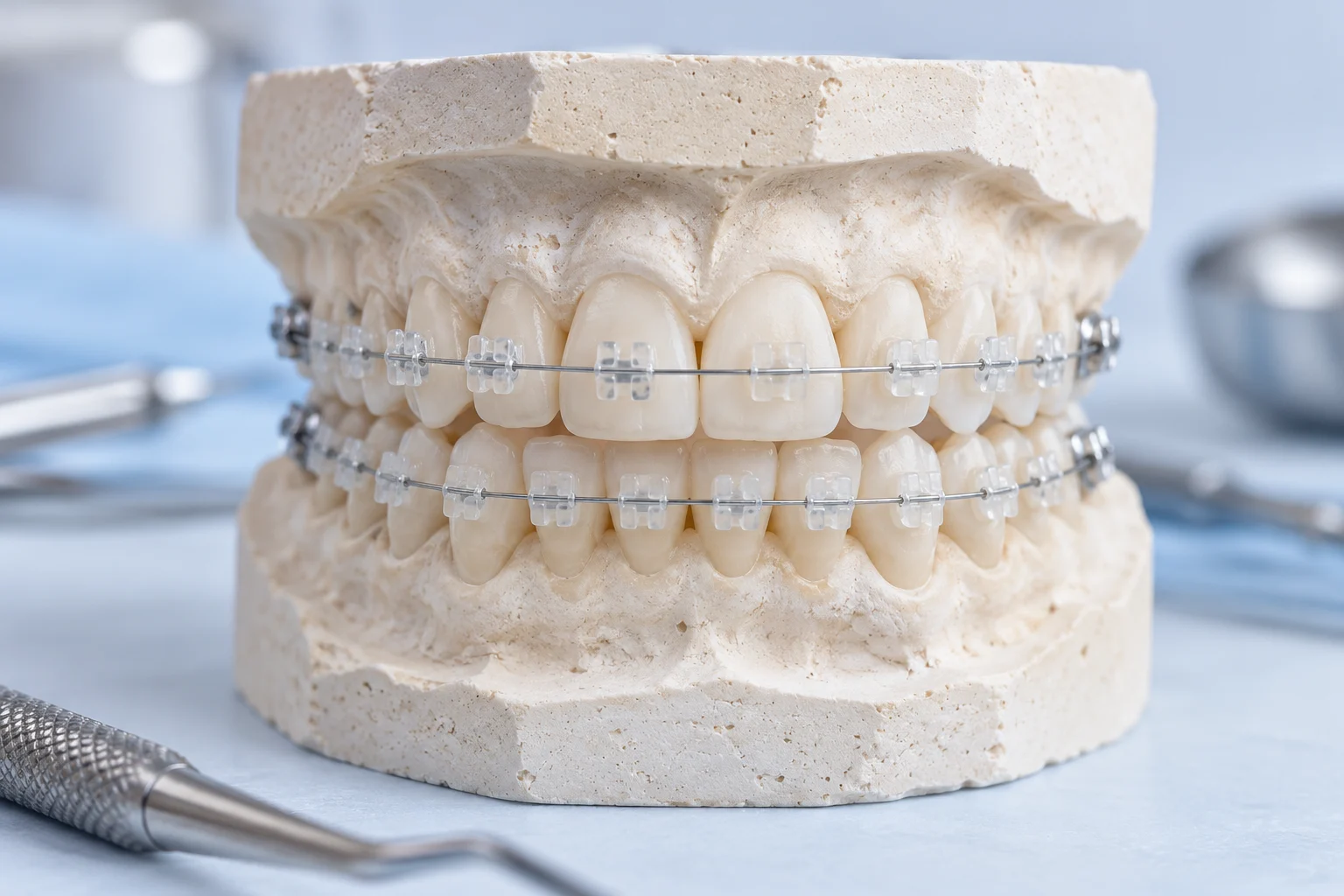
Clear braces are fixed braces that use tooth-coloured ceramic brackets joined by a frosted or tooth-coloured wire. Cleveland Clinic says they work the same way as metal braces. You will also hear them called ceramic braces or transparent braces.
Some people call them invisible braces, but they are not invisible and they show up close. Clear aligners and Invisalign use removable trays and are harder to spot.
- Ceramic brackets bonded to the front of each tooth
- A wire that guides the teeth into place
- Small elastic ties that hold the wire to the brackets
- Metal bands on the back molars to anchor the wire
- A retainer at the end to hold the result
What can clear braces fix?
Clear braces fix the same problems metal braces fix. Cleveland Clinic lists these:
- Crowded or overlapping teeth
- Gaps between teeth
- Overbite and underbite
- Crossbite, where the lower teeth sit outside the upper teeth
- Open bite, where the front teeth do not touch
Crowded teeth are harder to clean, so lining them up makes brushing and flossing easier and lowers your risk of cavities and gum disease.
Who are clear braces not right for?
Clear braces are not right for anyone with untreated decay or gum disease. Cleveland Clinic warns that placing braces on diseased teeth can seriously harm your oral health. Healthy teeth come first. Any cavity or gum disease is treated before the brackets go on.
Ceramic brackets are also more fragile than metal ones. Cleveland Clinic says they break more easily and repairs add to the cost. Ceramic brackets that your teeth bite against can wear the enamel of those teeth, so ask the dentist to check your bite for this at the exam.
What are the benefits of clear braces?
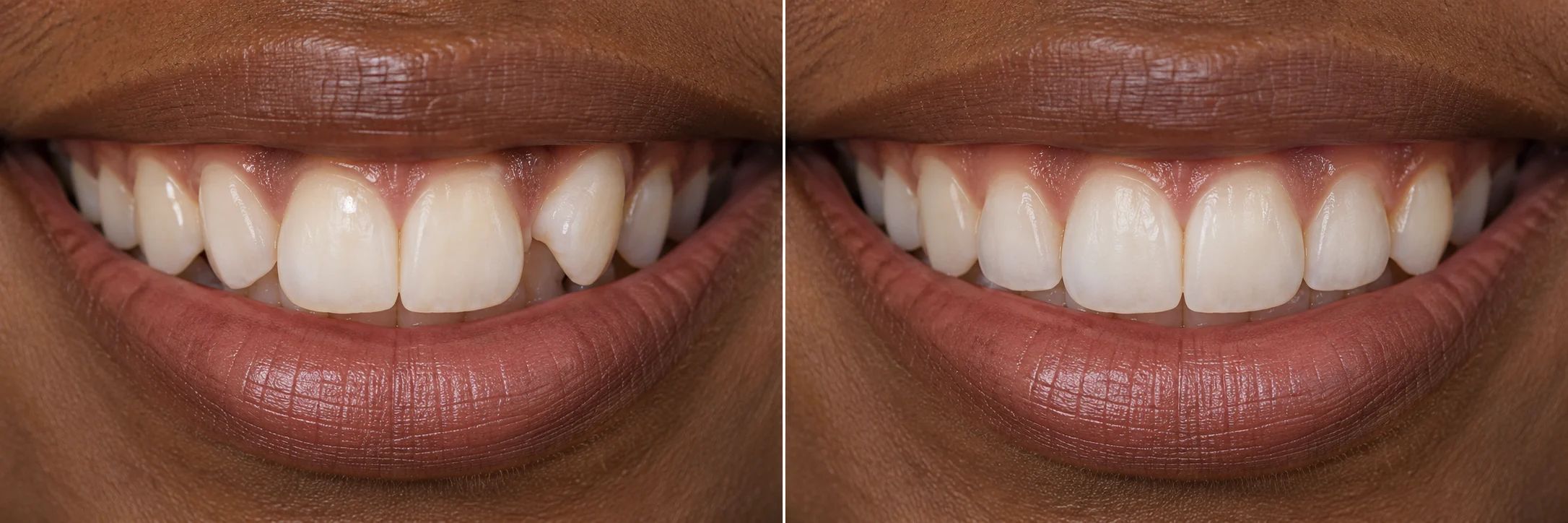
The main benefit of clear braces is a less noticeable look with the fixed control of braces.
- Ceramic brackets blend in with your teeth in photos and at work.
- Braces stay on, so treatment never depends on remembering to wear trays.
- Clear braces treat the same range of problems as metal braces for adults and teens.
How do clear braces compare with metal braces?
Clear braces and metal braces move teeth with the same brackets and wire. The table shows where they differ.
| Clear (ceramic) braces | Metal braces | |
|---|---|---|
| How they look | Tooth-coloured brackets that blend in | Silver brackets that show |
| Strength | More fragile and break more easily | Stronger stainless steel |
| Staining | Stain more easily | Less prone to staining |
| Treatment time (Cleveland Clinic) | 12 to 36 months | About 20 months on average |
| Cost | Higher | Lower |
| When it is wrong for you | Your teeth bite on the brackets, or you will not give up hard foods | You want braces that draw less attention |
Metal braces are the stronger and lower-cost option, and you can compare them on the metal braces page before you decide. Both kinds of braces in North York start with the same exam.
What are the downsides and risks of clear braces?
The main risks of clear braces are decay and gum problems around the brackets and root shortening. Ceramic can also wear the opposing teeth, and teeth drift back without a retainer. Know the risks before you start.
- White spots and decay. Plaque collects around brackets. A 2015 meta-analysis of 14 studies found new white spot lesions in 45.8% of patients during fixed-brace treatment. A white spot is the first stage of decay.
- Gum problems. Cleveland Clinic lists braces as raising the risk of gum overgrowth, called gingival hyperplasia.
- Root shortening, called root resorption. A 2010 systematic review found that full orthodontic treatment makes it more common and more severe. Heavy forces look especially harmful. Most root shortening is minor, but lost root length does not grow back, and severe cases can mean changing or stopping treatment.
- Wear on opposing teeth. In a 1990 lab study, ceramic brackets wore away more enamel from the teeth biting against them than steel brackets did.
- Relapse. Teeth drift back toward their old positions if you stop wearing your retainer.
Call (416) 742-3636 if pain lasts more than a few days after a fitting or adjustment. Call too if your gums turn very red and swollen or a bracket or wire breaks. Call 911 or go to the nearest hospital emergency department if you have trouble breathing or swallowing, swelling that spreads toward your eye or neck, fever with facial swelling, or bleeding that will not stop.
How do you get clear braces in North York?
Getting clear braces in North York starts with an exam at the clinic on Jane Street. A plan comes next, then the fitting and regular adjustment visits. The clinic offers four kinds of teeth straightening: clear braces, metal braces, clear aligners and Invisalign. You can compare all four at one office.
How are clear braces put on?
Placement is a short series of steps. The brackets are bonded to the front of your teeth, the wire runs through them and elastic ties hold it in place. Cleveland Clinic says placement takes about an hour or two. The team explains your own fitting schedule after the assessment.
Your teeth feel tender for a few days afterwards, so plan soft meals for those days.
What to expect during clear braces treatment
Clear braces treatment follows the same steps for teens and adults.
- Digital X-rays and an exam of your bite, teeth and gums.
- A treatment plan that maps each tooth's movement.
- The fitting visit for the brackets and wire.
- Regular adjustment visits to change the wire and check your progress.
- Removal of the braces and a retainer to hold your teeth in place.
Can adults get braces in North York?
Adults can get braces in North York. Age is not the barrier. The NHS notes that adults can have braces as well as children and teens, and clear braces suit adults who want treatment to show less at work.
Adult teeth move the same way a teen's do. Braces need healthy support, so the exam checks your gums and bone and any crowns or fillings before a plan is made.
Did your teeth shift after braces as a teen? Braces can move them back. Wear your retainer as prescribed to lower the risk of your teeth shifting again.
Adult facial bones have stopped growing. Cleveland Clinic explains that some treatments happen in childhood because a child's bones are easier to move. Some bite problems come from the jaws and not the teeth. The dentist looks for this at the exam, and you hear what braces can and cannot fix before you start.
How long do clear braces take?
Clear braces take 12 to 36 months by Cleveland Clinic's figures. Metal braces take about 20 months on average. Your own time depends on how far your teeth need to move. Bigger moves take longer.
Ceramic brackets are not as strong as metal, so Cleveland Clinic notes treatment can take slightly longer. Missed adjustment visits and broken brackets add time too. You get your own timeline as a range after the exam.
How do you care for clear braces?
Caring for clear braces comes down to two habits. Clean around every bracket and avoid foods that break them.
- Brush with fluoride toothpaste each morning and night and after meals.
- Clean between your teeth and under the wire every day with an interdental brush or a floss threader.
- Skip hard foods like nuts and ice, and sticky ones like caramel and gum.
- Cut sugary food and drinks, which feed decay around the brackets.
- Keep up your regular dental cleanings and check-ups during treatment.
How much do clear braces cost in Toronto?
Full treatment with clear (ceramic) braces starts at about $4,000 in the prices other Toronto clinics publish. Their published prices for metal braces start at about $3,000 to $4,000. Longer and more complex cases cost more. Your own cost comes in a written estimate after an exam.
Your cost depends on:
- How far your teeth need to move and how long treatment runs
- Whether you choose ceramic or metal brackets
- Repairs for broken brackets, which Cleveland Clinic says can cost more with ceramic
- The retainer after treatment
Dental insurance pays toward braces only when your plan has orthodontic benefits. Ask your insurer for a predetermination before treatment starts. Direct billing is available at the clinic, and you can ask about financing options.
Clear braces FAQs
Patient feedback
What Our Patients Are Saying
We’re proud of the relationships we build with our patients. Read feedback from individuals and families who have trusted us with their dental care.
Really happy I came here! They accept the CDCP, which made my visit affordable and stress-free. Great service and friendly team!
FadendasPatient feedback
Hugh describes a long relationship with the clinic, having attended for nine years at the time of his review.
Merna shares that she enjoys attending dental visits with the rest of her family.
Frank recommends the clinic and describes the dentist and staff as friendly and knowledgeable, which helped him enjoy his dental visits.